Dry Rot vs Wet Rot: What St. Louis Homeowners Need to Know
Dry rot (Serpula lacrymans) is the more dangerous type — it can spread through masonry to reach dry wood and is difficult to fully eradicate. Wet rot stays confined to areas with an active moisture source. Knowing which you have determines how aggressively you need to act.
| Feature | Dry Rot | Wet Rot |
|---|---|---|
| Spread pattern | Beyond moisture source, through masonry | Confined to wet area only |
| Danger level | High — structural risk across building | Moderate — localized to moisture zone |
| Eradication difficulty | High — spores persist for years | Lower — fix the leak, stop the rot |
A guide to identifying dry rot vs wet rot in St. Louis homes, understanding which is worse, and knowing when to call a specialist before the damage spreads.
Updated 2026-05-28 · Wood Rot Experts Editorial Team
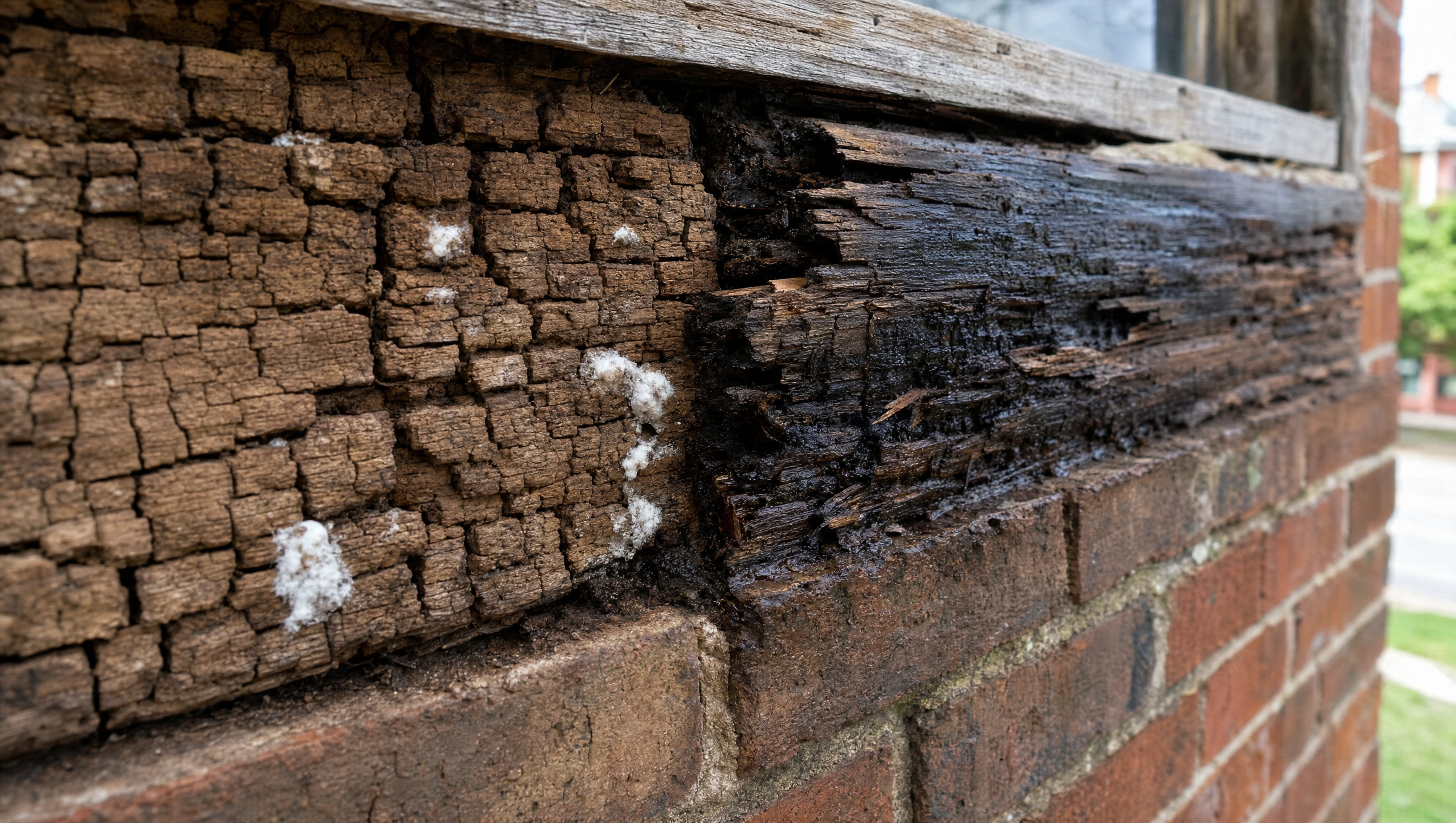
Not all wood rot is the same. When St. Louis homeowners discover dark staining on a window sill or soft, crumbling wood on a porch railing, the natural assumption is that it's one problem with one solution. It isn't. Dry rot and wet rot are caused by different fungi, behave differently, and demand different responses. Misidentifying the type can mean spending money on a repair that fails within a season.
I've inspected hundreds of St. Louis homes over the years — from century-old Soulard rowhouses to mid-century ranches in Chesterfield — and the most important first step is always the same: correctly identify what you're dealing with before touching anything.
What Is Dry Rot?
Despite its name, dry rot requires moisture to germinate. Specifically, it needs wood moisture content between 28% and 32% to take hold. The “dry” refers to what the rot leaves behind: wood that looks and feels parched, cracked into small cube-like pieces, and has lost all structural strength while appearing almost desiccated.
It is caused by a single fungus: Serpula lacrymans. What makes dry rot uniquely dangerous is its biology. Unlike most fungi, it produces long, root-like structures called hyphal strandsthat can transport moisture and nutrients through brick mortar, concrete, and plaster. This allows it to travel from a wet area to reach and colonize structurally dry wood — sometimes several meters away from the original water source. By the time you see the damage, the fungus has often already spread far beyond what's visible.
How to Identify Dry Rot
- Cuboid cracking: The wood breaks apart into small, roughly cube-shaped pieces — this is the most reliable visual indicator.
- White mycelium: A fluffy, cotton-like white or grey growth on the surface, often visible in corners or behind paneling.
- Orange fruiting body: In advanced cases, a pancake-shaped fruiting body (sporophore) appears — rust-orange or ochre in color — producing orange-red spore dust.
- Musty smell in dry conditions: The fungus produces a distinctive earthy, mushroomy odor even when the surrounding area has dried out.
- Wood shrinks away from fittings: Timber around door frames or window fittings may appear to have pulled back from its original position.
What Is Wet Rot?
Wet rot is a broader category — it refers to decay caused by several fungal species, most commonly Coniophora puteana (cellar fungus) and Fibroporia vaillantii. Unlike dry rot, wet rot fungi require a sustained moisture source to survive. They cannot spread through masonry or travel to dry wood. When you fix the leak or eliminate the moisture, wet rot stops. This is the critical distinction.
Wet rot is more common in St. Louis than dry rot, but it is also more contained. You'll find it in decks with poor drainage, exterior siding beneath broken gutters, wood frames around leaking windows, and any timber in persistent ground contact. Learn more about the early signs of wood rot to catch either type before it progresses.
How to Identify Wet Rot
- Longitudinal splitting: The wood splits along the grain in long, parallel cracks — rather than the cuboid pattern of dry rot.
- Dark staining: Brown, black, or very dark discoloration of the wood fibers, often clearly tracing the moisture path.
- Spongy when wet, brittle when dry: Press your thumb into suspect wood. Wet rot feels soft and spongy when damp; the same area crumbles or breaks away cleanly when dried out.
- Localized to the moisture zone: The damage is almost always directly at or immediately around the source of moisture — a leaking gutter, failed caulk, or pooling water.
- Mushroomy smell near the moisture source: Stronger and more localized than dry rot's odor, and disappears once the area dries.
Dry Rot vs Wet Rot: Side-by-Side Comparison
| Characteristic | Dry Rot | Wet Rot |
|---|---|---|
| Fungus species | Serpula lacrymans (one species) | Multiple species (Coniophora puteana most common) |
| Crack pattern | Cuboid — wood splits into small cube-like fragments | Longitudinal — splits along the wood grain |
| Color | Light brown, grey-white mycelium, orange fruiting body | Very dark brown to black staining |
| Texture | Dry and brittle; crumbles to powder | Soft and spongy when wet; brittle when dried |
| Can spread through masonry? | Yes — hyphal strands penetrate brick and mortar | No — confined to wood |
| Requires active moisture? | To establish, yes. But can self-sustain once active. | Yes — always needs a continuous moisture source |
| Fix the leak, fix the problem? | No — treatment and removal required regardless | Usually yes — eliminate moisture, rot stops progressing |
| Relative danger | High | Moderate |
Why St. Louis Is Particularly Vulnerable to Both
St. Louis creates near-ideal conditions for both rot types. Average relative humidity reaches 72% in July. Annual rainfall is approximately 38 inches, with significant spring events that saturate soil and foundations. The freeze-thaw cycle — the metro area averages nearly 100 freeze-thaw events per year — repeatedly stresses caulk seals, paint films, and wood joints, opening entry points for moisture year after year.
The older housing stock compounds the risk. Neighborhoods like Kirkwood, Webster Groves, Tower Grove South, Maplewood, and Soulard are filled with homes built between 1890 and 1950. These homes have beautiful original millwork, but also aging wood sills, settled foundations, and gutters that haven't been properly maintained in decades. The combination creates the trapped-moisture pockets that both dry rot and wet rot need to establish. For more on how STL's seasonal cycles accelerate damage, see our guide to freeze-thaw wood damage in St. Louis.
We also see elevated humidity-driven wood rot in areas with poor ventilation — enclosed crawl spaces, attic knee walls, and the underside of porches where air barely moves and summer moisture has nowhere to go.
The Screwdriver Test: Your First Field Check
Before calling anyone, do this: press the tip of a standard screwdriver firmly into the suspect wood. A single, firm push — not a sharp stab.
- Sinks more than ½ inch with little resistance: Active rot is present. The wood has lost structural integrity. Professional assessment required.
- Tip enters slightly but stops on solid wood: Surface rot only. May be addressable with epoxy repair if the extent is confirmed.
- No penetration at all: The wood is sound. What you're seeing may be surface staining, weathering, or mill defects — not rot.
If the screwdriver sinks easily AND you see cuboid cracking or white mycelium nearby, treat this as potential dry rot and call a specialist immediately. Do not attempt to clean or treat the area yourself — disturbing dry rot mycelium can release spores and spread the problem. Read our full guide on identifying and preventing wood rot for a complete inspection checklist.
Treatment Approach: Dry Rot vs Wet Rot
The treatment philosophies are fundamentally different, which is why accurate identification matters so much before any repair begins.
Treating Wet Rot
The core principle is simple: eliminate the moisture source first. Without it, the fungus cannot survive. Once the leak is fixed, the caulk is replaced, or the drainage is corrected, wet rot stops progressing. Treatment then involves:
- Removing all visibly affected wood (cut back to sound timber)
- Treating surrounding wood with a fungicide or borate solution as a precaution
- Replacing removed sections with pressure-treated or pre-treated timber
- Sealing and painting the repair to prevent future moisture intrusion
For smaller non-structural affected areas, an epoxy-borate consolidant repair is often a durable and cost-effective option. See our guide on door frame repair for a practical example of this approach.
Treating Dry Rot
Dry rot treatment is more involved and more expensive. Simply fixing the moisture source is not enough — the fungus has already established a network that can survive and re-infect even after the original moisture is removed. A professional dry rot remediation will typically involve:
- Full extent mapping: Probing and opening walls or cavities to trace how far the hyphal strands have spread — often several feet beyond visible damage
- Removal with margin: Cutting back affected timber with a substantial margin (typically 18 inches) beyond the last visible sign of infection
- Masonry treatment: Treating adjacent masonry with a fungicide to kill hyphal strands that may have penetrated brick or mortar
- Borate treatment of remaining timber: Applying a penetrating borate solution to all timber in the affected zone to prevent re-colonization
- Moisture source remediation: Fixing the original moisture source and improving ventilation to prevent conditions from returning
If the dry rot has reached structural elements — a floor joist, a structural beam, or load-bearing framing — this becomes a structural repair involving temporary supports and engineered fixes, not a DIY project under any circumstances.
Frequently Asked Questions
What is the difference between dry rot and wet rot?
Dry rot (Serpula lacrymans) produces cuboid cracking, white fluffy mycelium, and an orange fruiting body, and can spread beyond its moisture source through masonry. Wet rot stays confined to the area with an active moisture source and causes longitudinal splitting with dark staining. Dry rot is significantly more dangerous and harder to eradicate.
Is dry rot or wet rot worse?
Dry rot is worse. It can spread through brick mortar and masonry to reach structurally dry wood far from the original moisture source, and its spores can lie dormant for years. Wet rot is more common in St. Louis but is contained — eliminate the moisture source and the fungus stops. Dry rot requires active remediation regardless of whether the moisture source is fixed.
How do I know if I have dry rot or wet rot?
Dry rot: cuboid cracking (wood breaks into small cubes), fluffy white mycelium sheets, possible orange fruiting body, musty smell even in dry conditions. Wet rot: longitudinal splitting along the grain, dark brown or black staining, soft and spongy when wet, brittle when dry, smell strongest near an active leak. When in doubt, use the screwdriver test — if it sinks more than half an inch with little resistance, call a specialist regardless of which type it appears to be.
Can dry rot spread to dry wood?
Yes — this is what makes dry rot uniquely dangerous. Serpula lacrymans produces hyphal strands that travel through masonry, plaster, and brick mortar to reach wood that has not yet been exposed to a direct moisture source. Once established, it can also extract moisture from surrounding materials to sustain itself. This is why mapping the full extent of dry rot before any repair work begins is critical.
Does St. Louis climate cause more dry rot or wet rot?
Both are common in St. Louis. The humid summers and heavy spring rainfall create the sustained moisture conditions wet rot requires year-round. The older housing stock in Kirkwood, Webster Groves, and South City neighborhoods — with aging caulk, settled foundations, and poorly maintained gutters — creates the trapped-moisture pockets dry rot needs. The freeze-thaw cycle opens new moisture entry points every winter, feeding both types.
Related Guides
Signs of Wood Rot
How to identify wood rot before it spreads.
Wood Rot Identification & Prevention
Complete homeowner checklist for catching rot early.
Humidity & Wood Rot in St. Louis
Why summer humidity accelerates rot in STL homes.
How to Prevent Wood Rot
Maintenance steps that stop rot before it starts.
Epoxy-Borate Wood Rot Repair
When consolidant repair is the right choice.
Get a Free Assessment
Connect with a vetted St. Louis wood rot specialist.
Stop Wood Rot Before It Spreads
Wood rot doesn't improve on its own — it only gets worse and more expensive. Get matched with a vetted local specialist and discover how much you can save with expert repair.
Serving all of Greater St. Louis including Clayton, Webster Groves, Kirkwood, Ballwin, Chesterfield, and surrounding areas