Repair or Replace Rotted Wood? A St. Louis Homeowner's Decision Guide
Repair when less than 40–50% of the wood is compromised and the piece is non-load-bearing. Replace when structural integrity is at risk, more than half the wood is affected, or a prior repair has already failed. The screwdriver test is the fastest field check.
| Indicator | Repair | Replace |
|---|---|---|
| % of wood compromised | Under 40–50% | Over 50% |
| Structural role | Non-load-bearing trim, sill, fascia | Posts, joists, beams, headers |
| Typical cost | $250–$800 | $500–$5,000+ |
A practical decision framework for St. Louis homeowners weighing wood rot repair against full replacement — with cost comparisons and local factors that affect the right call.
Updated 2026-05-28 · Wood Rot Experts Editorial Team
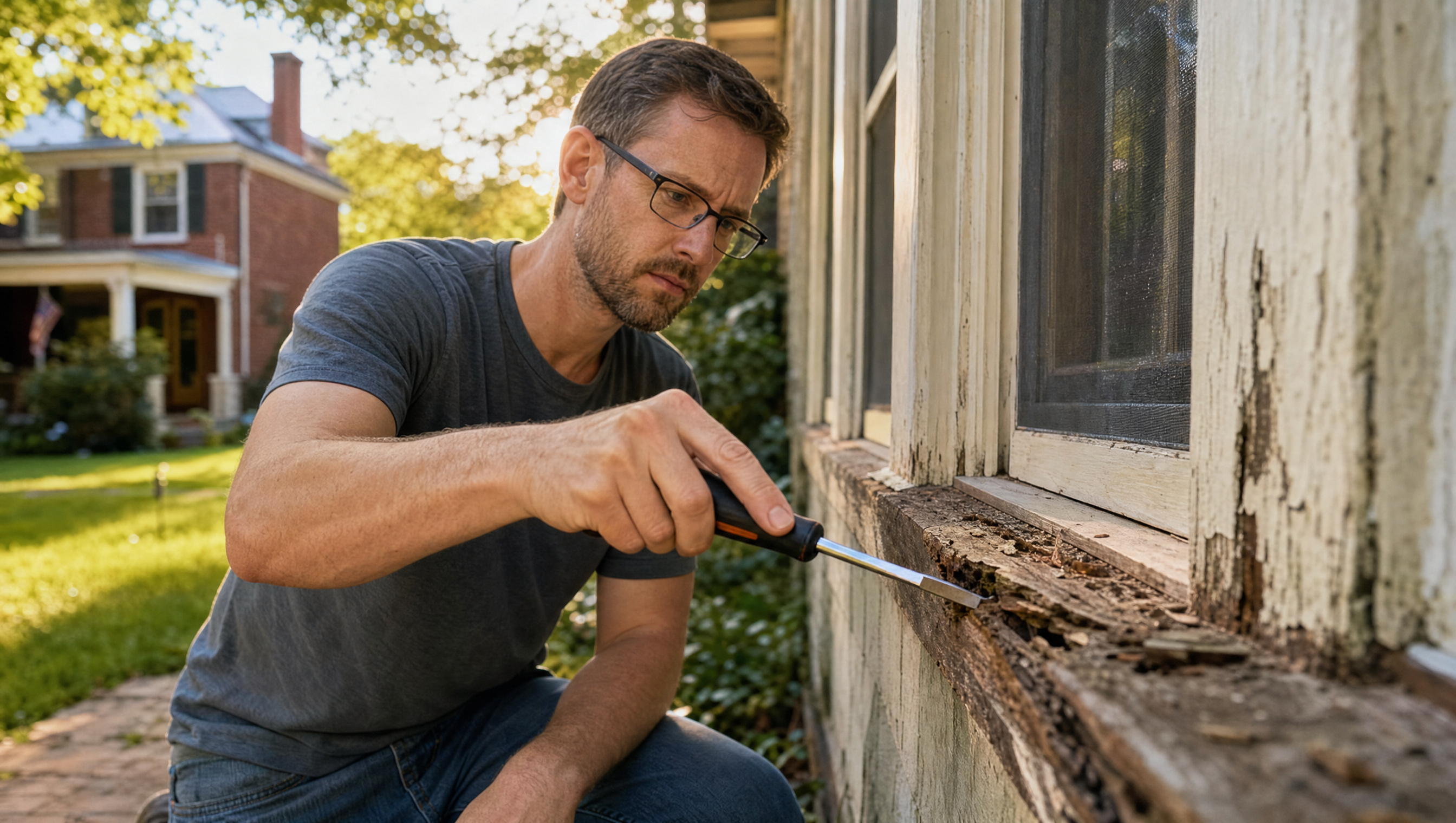
When a homeowner in Clayton calls us about a soft window sill or a homeowner in Webster Groves discovers rot in a deck post, the first real question is always the same: does this need to be repaired, or does it need to come out entirely? The answer affects your budget, your timeline, and — most importantly — how long the fix actually lasts.
There is no universal answer. Getting this wrong in either direction is costly. Repairing wood that should be replaced means the repair fails prematurely and you pay twice. Replacing wood that could have been repaired means unnecessary cost, paint-matching challenges, and in older St. Louis homes, the potential loss of original millwork you cannot easily replicate.
Here is the framework we use in the field.
The Screwdriver Test: Start Here
Before any other assessment, press the tip of a standard flathead screwdriver firmly into the suspect wood. Apply steady pressure — not a sharp jab.
- Tip sinks more than ½ inch with minimal resistance: The wood has lost structural integrity. Replacement is likely required, or at minimum, a specialist needs to determine how far the damage extends.
- Tip enters slightly but encounters solid resistance: Surface rot only. Repair is a viable option if the total affected area is under 40–50% of the piece.
- No penetration at all: The wood is structurally sound. What you're seeing may be surface staining or weathering. Monitor it, but no immediate action required.
The screwdriver test does not tell you how far the rot has spread laterally — only a thorough inspection with probing at multiple pointsreveals the full picture. But it is the fastest way to determine whether you're dealing with surface damage or structural compromise.
When to Repair: The Case for Epoxy Consolidation
A properly executed epoxy-borate consolidant repair is not a patch job — it is a structural restoration of the remaining sound wood fibers. Done correctly, it outlasts many replacement alternatives in non-structural applications. The right conditions for repair are:
- Less than 40–50% of the wood's cross-section is compromised. You need a majority of the wood's original fiber to remain for the consolidant to bond with and the epoxy to key into.
- The core is structurally intact. Screwdriver test confirms the inner wood is solid.
- The piece is non-load-bearing. Window sills, door trim, fascia boards, soffit, decorative columns, and exterior casing are ideal candidates. Floor joists, structural beams, and load-bearing posts are not.
- The moisture source has been — or can be — permanently fixed. There is no point repairing wood if the water source that caused the rot is still active. Repair is the second step, not the first.
- This is the first repair at this location. A second repair at the same spot after a prior repair failed is a signal that replacement is needed.
Common repair candidates in St. Louis homes: exterior window sills on pre-war homes (where original profiles are hard to replicate), fascia and soffit boards where the rot is on the face only, door frame sections where the jamb is sound but the casing has surface rot, and decorative trim on porches and dormers.
When to Replace: Non-Negotiable Replacement Criteria
Some situations make replacement the only responsible choice. There is no repair that reliably handles these scenarios:
- Structural or load-bearing members. Deck posts, floor joists, roof rafters, structural headers above windows and doors, and any framing member that carries load cannot be patched with epoxy. The margin for error is zero. See our structural repair service for how we handle these jobs.
- More than 50% of the cross-section is compromised. When the majority of the wood has lost its integrity, there is not enough remaining fiber for a consolidant repair to anchor to effectively.
- The rot has migrated through multiple layers. If you find rot in the surface board and probing reveals it has reached the sheathing or framing behind it, the affected layers all come out.
- Active moisture source cannot be eliminated. If a gutter cannot be properly repaired, a flashing detail cannot be fixed, or a grading issue will keep soil saturated against the foundation, the repair will fail within a season or two.
- A previous repair at the same location has already failed. Two failed repairs at the same spot mean the conditions are hostile enough that replacement with more durable material is the right answer.
- The piece is accessible for standard replacement. Sometimes replacement is simpler and faster than repair — a single deck board or a piece of lap siding may take as long to repair as to replace, with a more predictable outcome.
Cost Comparison: Repair vs Replacement in St. Louis (2026)
Cost should be a factor in the decision, but not the primary one. A cheaper repair that fails in 18 months costs more than a slightly more expensive replacement that holds for 20 years. That said, understanding the cost ranges helps set realistic expectations:
| Location | Epoxy Repair | Full Replacement | Notes |
|---|---|---|---|
| Window sill | $300–$600 | $500–$1,200 | Repair often preserves original profile on historic homes |
| Door frame / jamb section | $250–$500 | $400–$800 | Replace if threshold or underlying framing also soft |
| Fascia board (10–15 ft) | $350–$700 | $600–$1,500 | Second-story access adds cost to both options |
| Deck board (1–3 boards) | $300–$600 | $400–$900 | Replace if substructure joists are soft |
| Deck post (structural) | Not appropriate | $800–$2,000 per post | Requires temporary shoring; structural work only |
| Siding section (small area) | $400–$700 | $600–$1,500 | Paint matching often adds cost to replacement |
*Estimates for informational purposes only. Actual costs require on-site assessment. See our full wood rot repair cost guide for detailed breakdowns.
St. Louis-Specific Factors That Affect the Decision
The repair-or-replace decision in St. Louis has several local wrinkles that don't apply everywhere:
Pre-1978 Homes and Lead Paint Testing
Neighborhoods like Kirkwood, Webster Groves, Tower Grove South, the Hill, and University City have enormous concentrations of pre-1940 housing. Any work that disturbs painted surfaces on homes built before 1978 may require lead paint testing and potentially EPA Renovation, Repair, and Painting (RRP) compliance. This adds $200–$500 to the cost of any replacement project but is often avoidable with a repair approach that leaves the original painted surface intact.
Old-Growth Lumber: Preserve When You Can
Many St. Louis homes built before 1960 contain old-growth pine or fir. This lumber is significantly denser, tighter-grained, and more resistant to future rot than anything available at a lumber yard today. When only the surface of an old-growth member has been compromised, repair is almost always preferable to replacement — the repaired old-growth piece will typically outperform a new modern-cut replacement board. I've seen well-executed epoxy repairs on 80-year-old window sills hold for 15-plus years. The same repair on modern lumber rarely holds as well. Learn more about how freeze-thaw cycles stress different lumber types.
Freeze-Thaw Stress on Repairs
The St. Louis metro experiences nearly 100 freeze-thaw cycles per year. Water expands when it freezes — if any moisture has penetrated an improperly sealed repair, the freeze-thaw cycle will work it apart. This is why borate pre-treatment and proper sealing are not optional steps in St. Louis repair work. A repair done correctly for this climate will handle the thermal cycling. A repair done without these steps will fail by the second winter.
Historic Millwork and Profile Matching
If your home has Victorian, Craftsman, or Colonial Revival millwork — common in Ladue, Clayton, and Central West End — the profile of original window casings, door surrounds, and cornice details may be impossible to replicate with standard lumber yard stock. Replacing a rotted section in a complex historic profile often requires custom milling at significant expense. In these cases, epoxy repair almost always pencils out better and preserves the architectural character of the home.
Decision by Location: Quick Reference
Not every wood component in your home carries the same stakes. Here is how we typically approach the repair-or-replace question by location:
| Location | Typical Recommendation | Key Qualifier |
|---|---|---|
| Window sill (exterior) | Repair first | Only if core sill and sub-sill are sound |
| Door casing / trim | Repair first | Replace if jamb or threshold is also compromised |
| Fascia / soffit | Repair first | Replace if rafter tails or structural blocking behind are soft |
| Deck boards (surface) | Case by case | Inspect joists; if joists are sound, repair or single-board replace |
| Deck posts / structural | Replace | No repair appropriate for load-bearing posts |
| Exterior siding (lap or board) | Case by case | Repair if surface only; replace if sheathing is wet |
| Floor joists / structural beams | Replace | Always structural work; never an epoxy application |
| Porch columns (decorative) | Repair first | Replace if load-bearing; assess structurally first |
Frequently Asked Questions
Is it better to repair or replace rotted wood?
Repair is better when less than 40–50% of the wood is compromised, the piece is non-load-bearing, and the moisture source is fixed. Replace when structural integrity is at risk, more than half the wood is affected, or a prior repair has already failed at the same location. The right answer depends on the specific piece — there is no blanket rule.
How do I know if rotted wood needs to be replaced?
The screwdriver test: press the tip firmly into the suspect wood. If it sinks more than half an inch with little resistance, the wood has likely lost structural integrity. Other replacement signals: rot has spread to more than half the piece, the member is load-bearing, previous repairs have already failed here, or the active moisture source cannot be permanently corrected.
Can you repair rotted wood without replacing it?
Yes — for non-structural, surface-to-moderate rot where less than half the wood is affected. A professional consolidant hardens remaining wood fibers, then an epoxy filler restores shape and surface. Done correctly, this is a durable solution for window sills, trim, fascia, and door frames. It is not appropriate for structural members carrying load.
How much does it cost to repair vs replace rotted wood in St. Louis?
Epoxy repair for small-to-medium non-structural rot runs $250–$800. Board or trim replacement typically costs $500–$2,000. Structural replacement (posts, joists, beams) ranges from $1,500–$5,000+. Homes built before 1978 in older STL neighborhoods may add $200–$500 for lead paint testing before any work that disturbs original painted surfaces. See our full wood rot repair cost guide for complete breakdowns.
Should I repair or replace a rotted window sill?
Repair is usually the right call when the rot is confined to the top surface and the sill is not load-bearing. A well-executed epoxy consolidant repair, properly sealed and painted, will outlast many replacement boards — especially if the original sill is old-growth lumber. Replace if the rot has spread to the sub-sill, the structural apron beneath, or the framing behind the sill opening.
Does the St. Louis climate affect the repair vs replace decision?
Yes. Nearly 100 freeze-thaw cycles per year puts more stress on repairs than in warmer climates — borate pre-treatment and proper sealing are essential, not optional. Many pre-1960 STL homes also have old-growth lumber that is denser than modern replacements, making a well-executed repair often more durable than a like-for-like board swap.
Related Guides
Wood Rot Repair Cost Guide
Price ranges for every repair type in the St. Louis area.
Epoxy-Borate Wood Rot Repair
How professional consolidant repair works — and when it holds.
How to Fix Rotted Wood
Step-by-step repair process from assessment to finishing.
Freeze-Thaw Wood Damage in St. Louis
How seasonal cycles affect the durability of repairs.
Structural Repair Services
When replacement of load-bearing members is required.
Get an On-Site Assessment
The only way to get an accurate repair vs replace determination.
Stop Wood Rot Before It Spreads
Wood rot doesn't improve on its own — it only gets worse and more expensive. Get matched with a vetted local specialist and discover how much you can save with expert repair.
Serving all of Greater St. Louis including Clayton, Webster Groves, Kirkwood, Ballwin, Chesterfield, and surrounding areas